The Principles in the 12 Steps of AA

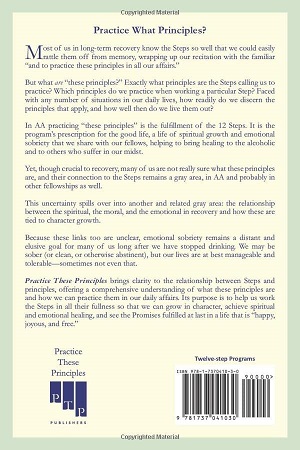
PTP23 Back cover

The principles in the 12 Steps of AA listed below are the principles in the 12 Steps of Alcoholics Anonymous only, not those in the 12 Steps of any other fellowship that may have adopted or adapted the 12 Steps from AA. The list is drawn directly and exclusively from the two Basic texts of AA: The Big Book and the 12&12. Most are referenced explicitly in the given Step in those texts, or they are referenced implicitly or can be reasonably inferred from them.  Some will be obvious, either because they are part of the text itself  (e.g. humility in Step 7, willingness in Step 8,  prayer and meditation in Step 11) or because they are mentioned repeatedly and discussed at length in the Big Book and/or the 12&12 (e.g., willingness in Step 3, honesty in Step 5). 

As will be seen, most Steps embody more than one principle. Moreover, the same principle may be embedded in more than one Step (e.g., honesty in Steps 1, 4, and 5), though their specific function may differ in each. Furthermore, a principle may be the main principle in a particular Step, but a secondary principle in another (e.g., prayer is primary in Step 11 but secondary—though important—in Step 3). Two particular principles, the discipline of surrender and the virtue of humility,  are foundational to each of the 12 Steps (even if they are not explicitly mentioned in all—or in the case of surrender, in any). That is, each Step requires us to relinquish our self-will and to admit our deficiency or insufficiency in one way or another. In some Steps, however,  these principles may be not only foundational but the primary operational principles. That is the case with surrender in Step 1 and with humility in Step 7.  

Some principles are not given their traditional names in the text of the Step (e.g., self-examination is rendered as making or taking inventory in Steps 4 and 10), but the traditional names nevertheless are used when discussed in the Big Book and the 12&12. The principles in each Step are listed in alphabetical order, not according to the order of their importance in that Step. If a principle is explicitly discussed in a Step, you can find the exact passage by searching 164andmore.com

For a full discussion of Steps 1-4, please see PTP123 and PTP4. Future books will discuss Steps 5-12. For a discussion of the principles in each of the 12 Steps,  please see their respective posts on this website in Practice These, where additional resources about them can be found.


Step One: “Admitted we were powerless over alcohol---that our lives had become unmanageable.” The Principles in Step One: The discipline of surrender. The virtues of acceptance, honesty, humility, open-mindedness, and willingness


Step Two: “Came to believe that a Power greater than ourselves could restore us to sanity.” The Principles in Step Two: The discipline of surrender. The virtues of faith, hope, honesty, humility, open-mindedness, simplicity, and willingness.


Step Three: “Made a decision to turn our will and our lives over to the care of God as we understood Him.” The principles in Step Three: The disciplines of prayer and surrender. The virtues of acceptance, faith, humility, serenity, and willingness.


Step Four: “Made a searching and fearless moral inventory of ourselves.” The Principles in Step Four: The disciplines of self-examination and surrender. The virtues of courage, diligence, honesty,  humility, perseverance, and willingness.


Step Five: “Admitted to God, to ourselves, and to another human being the exact nature of our wrongs.” The Principles in Step Five: The discipline of confession. The virtues of courage, discretion, faith, honesty,  humility, perseverance, prudence, and willingness


Step Six: “Were entirely ready to have God remove all these defects of character.” The Principles in Step Six: The discipline of surrender. The virtues of honesty, open-mindedness, patience, perseverance, and willingness.


Step Seven: “Humbly asked Him to remove our shortcomings.” The Principles in Step Seven: The discipline of prayer. The virtues of humility and willingness.


Step Eight: “Made a list of all persons we had harmed, and became willing to make amends to them all.” The Principles in Step Eight: The discipline of self-examination. The virtues diligence, forgiveness, honesty, humility, and willingness


Step Nine: “Made direct amends to such people whenever possible, except when to do so would injure them or others.” The Principles in Step Nine: The discipline of restitution. The virtues of consideration, courage, discretion, forthrightness, frankness, generosity, honesty, humility, justice, prudence, responsibility, sincerity, and tactfulness.


Step Ten: “Continued to take personal inventory and when we were wrong promptly admitted it.” The Principles in Step Ten: The disciplines of confession, restitution, and self-examination. The virtues of courage, diligence, forgiveness, honesty, humility, justice, patience, perseverance, and willingness. Depending on the nature of the harm done, Step 10 may call for practicing all of the principles in Steps 4—9. 


Step Eleven: “Sought through prayer and meditation to improve our conscious contact with God as we understood Him, praying only for knowledge of His will for us and the power to carry that out.” The principles in Step Eleven: The disciplines of meditation, prayer, self-examination, and surrender. The virtues of acceptance,  humility, and perseverance.


Step Twelve: “Having had a spiritual awakening as the result of these Steps, we tried to carry this message to alcoholics, and to practice these principles in all our affairs.”  The principles in Step Twelve: In Step Twelve, we practice the same principles as in the preceding eleven Steps, but we do so in all our affairs in recovery and not only with reference to our alcoholic past or alcohol-related problems. Nevertheless, there are four new principles in this Step. These are the disciplines of service, witnessing, and fellowship, and the virtue of love


To return to
Practice These, please click on link.